
QR pet tag vs Apple AirTag
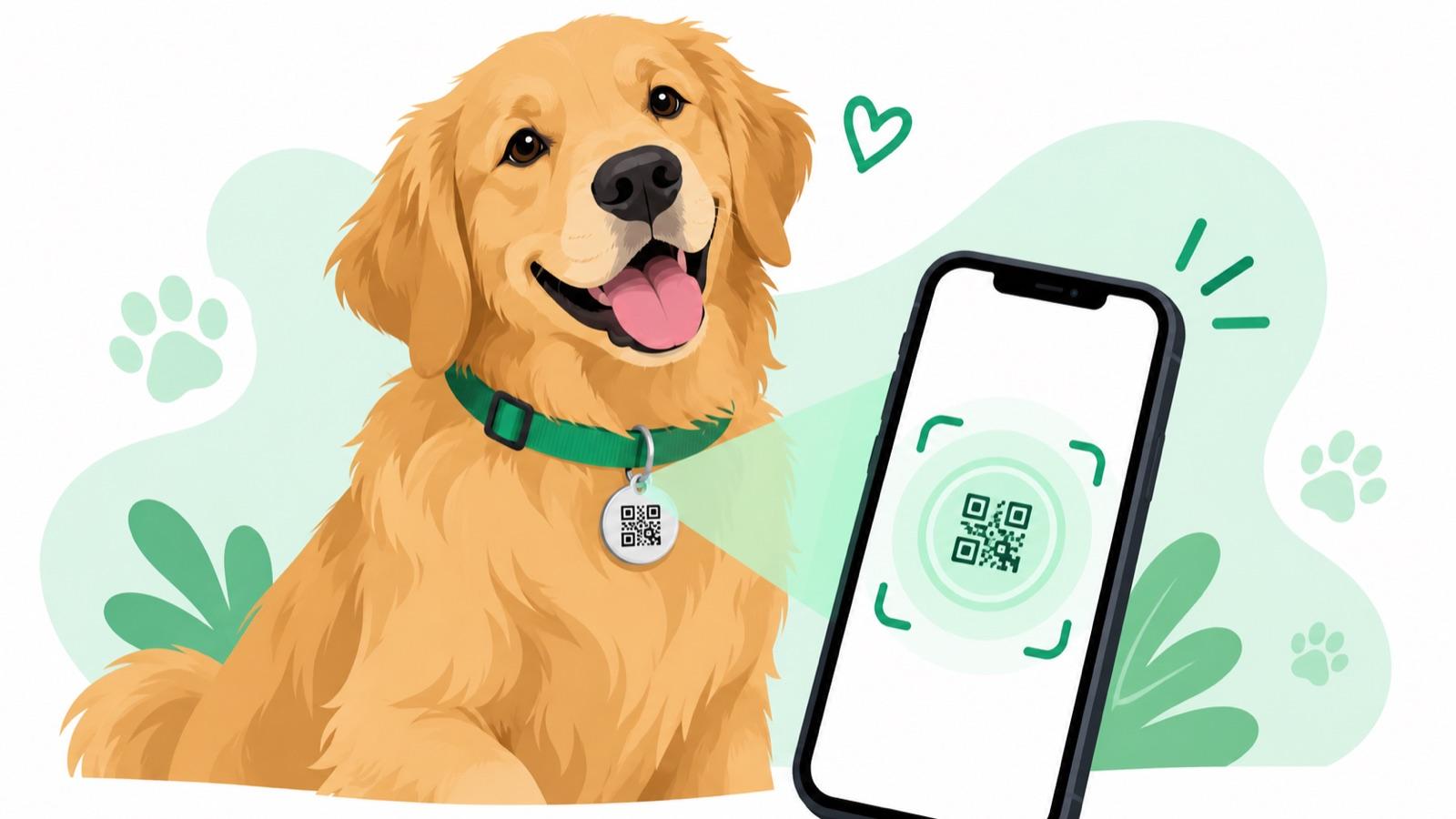
One shows a finder your number the moment they hold your dog. The other is a Bluetooth beacon you track yourself — and isn’t really built for pets. Here’s the honest comparison.
What each one actually does
They're often compared, but they answer different questions: 'who has my dog and how do they reach me?' versus 'where is my dog right now?'
| Kingston’s QR tag | Apple AirTag | |
|---|---|---|
| What it's for | Helping a finder reach you | Helping you find a location |
| Who can use it | Anyone with a phone camera | Only you, in Apple's Find My (iPhone) |
| Shows your contact | Yes, instantly | No — it's a beacon, with no contact details |
| Is it GPS? | N/A — it's an ID tag | No — Bluetooth, located via nearby iPhones |
| Battery | None, ever | Coin battery, replace about once a year |
| Safe on a dog | Yes — flat collar tag | Apple & vets discourage it; choking / battery risk if chewed |
| Works in rural areas | Yes — wherever a person is | Only if an iPhone passes nearby |
| Ongoing cost | None | Battery replacements; iPhone-only |
| Gets a lost dog home | A finder calls you directly | Only if you reach the spot yourself |
Why an AirTag isn't a lost-dog solution on its own
It's a clever way to find your keys. On a dog, three things about it matter — and all three catch owners out.
It's a tracker, not an ID tag
An AirTag is built to help you locate your own things. It has no screen and no way to show a stranger your phone number — so the neighbour holding your dog has nothing to call. It answers to you, not to them.
It isn't GPS
An AirTag has no GPS chip. It finds its position by pinging nearby iPhones in Apple's Find My network, which then report its rough location back to you. In a quiet neighbourhood or the countryside, with few iPhones passing, that location can be stale or simply blank.
Apple and vets discourage it on pets
Apple markets the AirTag for keys and bags, not animals, and vets raise two real risks: a dog can chew the small disc and choke, and a cracked lithium battery is toxic if swallowed. Several also warn it gives a false sense of security in place of a real ID tag.
None of this makes an AirTag useless — it can help you close the last hundred yards to a dog that’s nearby. It makes it a locator you operate, not something a finder can read, and not a substitute for an ID tag.
Most lost dogs are found by a person, not a map
And a person has a phone camera in their pocket, not your Find My app on their screen.
Only 6% of dog owners found their lost pet at a shelter.
Source: ASPCA
Most reunions happen when an ordinary person picks the dog up and looks for a way to reach the owner. An AirTag gives that person nothing to act on — there is no number on it. A tag they can scan or read turns their goodwill into a phone call.
- ✓A finder scans or reads the tag and calls you within minutes
- ✓No app, no battery, no iPhone required on either side
- ✓You choose exactly which contact details are shown
- ✓You update your own details online — instantly, no fee
- ✓Weatherproof, nothing to charge, nothing to chew loose
A tag for identification, a GPS collar for tracking
We sell QR tags, so weigh this accordingly: an AirTag sits in an awkward middle — not a real tracker, not an ID tag. Pick the tool for the job you actually need.
A QR or engraved tag
The thing that reaches whoever is holding your dog, with no battery, no app and no ecosystem lock-in. It’s the common case — a neighbour, a phone, a few minutes of goodwill — and it costs a few dollars once.
A real GPS collar
A purpose-built GPS tracker has its own cellular link and updates in real time — what an AirTag only looks like it does. If tracking a roamer or an escape artist is the goal, that is the device, not a Bluetooth beacon.
For most dogs, a readable ID tag is the first and cheapest line of defence. Thinking about a GPS tracker instead? Read QR tag vs GPS tracker.
QR tag & AirTag FAQ
Is an Apple AirTag a GPS tracker for dogs?+
No. An AirTag has no GPS and no cellular connection. It reports its position by borrowing the location of nearby iPhones in Apple's Find My network. Where lots of iPhones are around it can be fairly accurate; where few are — rural roads, quiet streets at night — it may show nothing useful. A purpose-built GPS collar is the device for real-time tracking.
Can an AirTag show a finder my phone number?+
No — and this is the core difference. An AirTag is a beacon for you to track, not a tag a finder can read. The person who finds your dog sees a plain disc with no contact details. A QR or engraved ID tag puts your number straight into their hands, which is what actually gets a dog home in the common case.
Is it safe to put an AirTag on a dog's collar?+
There are real cautions. The disc is a choking hazard if a dog chews it off, and the coin-cell lithium battery is toxic if the casing is cracked and swallowed. Apple markets AirTags for belongings rather than pets, and many vets advise against relying on one. If you do use one, a secured holder and supervision matter — and it still doesn't replace a readable ID tag.
AirTag or QR tag — which should I get for my dog?+
They do different jobs, so the honest answer is a tag first. A QR or engraved ID tag is what reaches a finder, needs no battery, works for anyone, and costs a few dollars once. An AirTag can help you walk toward a dog that's nearby, but only if an iPhone is in range and the battery is alive. If you want true live tracking, that's a GPS collar, not an AirTag.
Do I need an iPhone to use an AirTag?+
Effectively, yes. AirTags are set up and tracked through Apple's Find My on an iPhone or iPad, and they lean on the iPhone network to be located at all. If your household is Android, an AirTag is largely a non-starter — another reason a QR tag, which any phone camera can open, is the more universal choice for identification.
Weighing up every option? QR tag vs microchip vs GPS vs engraved, compared side by side — including five-year costs and how each one fails. Or read QR tag vs microchip.
Put a scannable tag on the collar tonight
Register the tag, add your dog's details, and any phone that points at it reaches you. No app for the finder, no battery to replace, no monthly fees for you.
Tags from $2.99. Serving pet families since 2021, from Raleigh, NC.