
QR pet tag vs GPS tracker
One tells you where your pet is. The other tells a stranger how to reach you. They solve different halves of the same bad day — here’s the honest comparison.
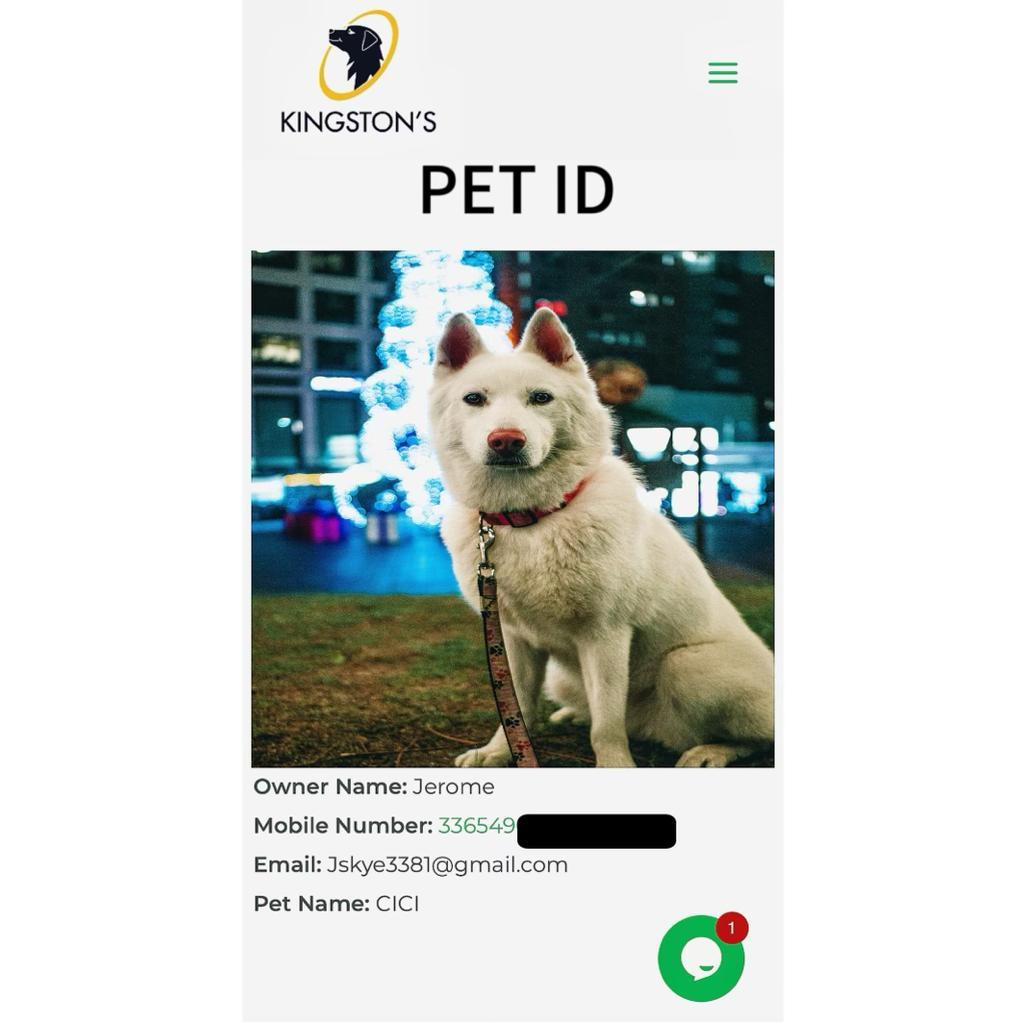
What each one actually does
A tracker is a location device. A tag is a contact device. Most of the differences below follow from that one distinction.
| Kingston’s QR tag | GPS tracker | |
|---|---|---|
| What it tells you | Who has your pet and how to reach them | Roughly where your pet is right now |
| Works while the pet is still running | No | Yes — that's its job |
| Works once a stranger picks the pet up | Yes — they scan and message you | Only if you drive to the location |
| Needs charging | No | Yes — a flat battery is a dead tracker |
| Needs a cellular plan | No | Yes — it stops reporting without one |
| Monthly fees | None | Ongoing subscription |
| Size on a small collar | Flat tag, works on cats and toy breeds | Bulky — often too heavy for small pets |
| Shows your contact details to a finder | Yes, exactly what you choose | No |
| What it needs from you | Register once, edit your details online anytime | Recharge on a schedule, keep the plan paid |
The moment that matters is the handoff
A GPS tracker is working hard right up until the second someone picks your pet up. After that, the thing you need is a way to talk to that person.
A location is not a phone number
A tracker can put a pin on a map two streets away. It cannot tell you that the pin is a stranger's living room, who that stranger is, or how to ask them to wait five minutes while you drive over.
Most pets are handed back, not hunted down
The usual ending isn't a search — it's someone noticing a loose dog, catching them, and looking for a way to reach the owner. That moment is a communication problem, not a mapping one.
The finder already owns the reader
Every phone camera opens a QR tag. There is nothing for the finder to install and nothing for you to keep charged, so the tag is working at 3 a.m. on day nine exactly as well as it was on day one.
This isn’t an argument against trackers. It’s the reason a tracker on its own leaves the last step of the reunion unfinished.
When a GPS tracker is genuinely worth it
There is one thing only a tracker does: it tells you where your pet is while they are still missing. For some pets that is worth every cent and every recharge.
Buy a tracker if…
Your dog bolts through open doors, slips a harness, or hunts. Your cat has outdoor access and a territory you can’t walk in an afternoon. You hike off-leash, or you live somewhere with real distance between houses. In all of those, the search itself is the hard part — and a live position turns hours of calling a name into a short drive.
Go in with clear eyes
- ✓It has to be charged, on a schedule you actually keep
- ✓It needs a cellular subscription to keep reporting
- ✓It's bulky — check the weight against your pet's collar
- ✓It shows a location, never the finder's phone number
- ✓Once someone takes your pet indoors, it's out of useful road
Around 10 million pets are lost or stolen in the US each year. Source: American Humane. A tracker helps you chase the ones still running; it does nothing for the ones already sitting in someone else’s kitchen.
What every pet needs either way
We sell QR tags, so weigh this accordingly: a tracker is optional and depends on your pet. Visible ID on the collar isn't optional for any pet.
A tag anyone can read
Nothing to charge, no signal needed on the tag itself, no monthly fee, and it fits a kitten’s collar. Whoever is holding your pet points their phone at it and can message you in seconds — and you choose whether your number and email are visible at all. Tags start at $2.99.
A tracker for pets that roam
If your pet genuinely covers ground, add one. Keep it charged, keep the plan active, and treat it as the tool for the part of the story where your pet is still on the move — not as the thing that brings them home at the end.
Put ID on the collar first, add a tracker if the pet needs one, and keep a microchip underneath as the permanent backup. Read QR tag vs microchip next.
QR tags & GPS trackers FAQ
Is a QR tag better than a GPS tracker?+
Neither replaces the other. A GPS tracker is the only thing that tells you where your pet is while they're still moving. A QR tag is the fastest way for whoever ends up holding your pet to reach you. If you can only do one, start with the tag — it's the cheaper baseline and it covers the most common ending.
Is there a pet tracker without a subscription?+
Not a real-time one. Live GPS location has to travel over a cellular network, and that network access is what the monthly fee pays for. A QR tag has no fee because there's no network on the tag at all — the finder's own phone does the work.
Do I need a GPS collar for my dog?+
It depends on the dog. If yours bolts at the door, slips leashes, has a strong prey drive or spends time off-leash on open land, a tracker earns its keep. For a dog who stays in a fenced yard and walks on a leash, the far more likely scenario is a gate left open and a neighbor two doors down holding your dog — which is a tag's job.
What happens to a GPS tracker when the battery dies?+
It stops reporting. The collar still looks like a tracker, but the app shows the last known position and nothing more. That's the main practical failure mode people run into, and it's why a passive tag alongside it is useful — a QR tag has nothing to run out of.
Can I use a QR tag and a GPS tracker together?+
Yes, and that's the setup we'd suggest for a dog that genuinely roams. The tracker helps you get to your pet; the tag gets your pet back to you if a person reaches them first. They cost nothing to combine beyond the tag itself.
Cover the handoff tonight
Register your tag, add your pet's details, and any phone that points at it reaches you. Nothing to charge, nothing to renew.
Tags from $2.99, with no monthly fees. Serving pet families since 2021, from Raleigh, NC.